The Volvo 850 estate that raced in the BTCC: the cylinder head controversy
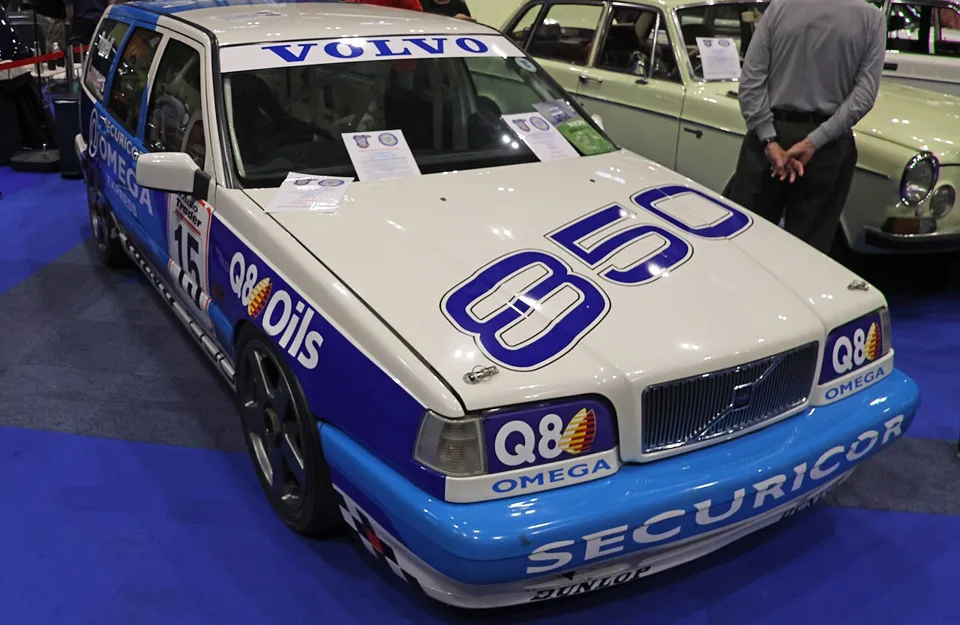

In 1994 Volvo put a station wagon on the grid of the British Touring Car Championship. The estate never won a race, but the engine under its bonnet caused more argument than its body shape.
An estate in a touring car championship
Volvo announced its BTCC return for 1994 under a three-year agreement with Tom Walkinshaw Racing, better known as TWR. The car they showed was the 850 estate, driven by Rickard Rydell and Jan Lammers. It was front-wheel drive, the engine was lowered and moved rearward, and the gearbox was a six-speed sequential unit, according to Volvo's own exhibition notes and the 1990s BTCC history site.
The class rules for 1994 asked for a naturally aspirated engine of up to two litres, with a standard body shell. The 850's road engine was a turbocharged five-cylinder, so the race engine was a different proposition: a two-litre, naturally aspirated five turning at around 8,500 rpm. That left the cylinder head as the place where the real engineering fight would happen.
What TWR did to the cylinder head
The regulations required a cylinder head from the production car. They allowed some freedom to change what sat in it, such as valves and camshafts. What they did not allow, as one account of the car puts it, was a free hand with the casting itself.
Volvo's history describes what TWR did anyway. The head was reworked to take larger camshafts and valves and bigger ports, and the geometry was changed so the valves sat at a different angle. A steeper intake path is what gives an engine like this its breathing, and breathing is where power comes from. The same account says no explicit rule forbade the work.
It did not come cheap. A reported figure is about 150,000 Swedish kronor for the race cylinder head, against about 2,000 kronor for the standard part.
The argument: is it still a production head?
The BTCC of the mid-1990s was a hard-fought championship between manufacturers, and the 850's engine was queried constantly. The Volvo account says the head was questioned at every race, and each time it was found to be within the regulations. Charlie Bamber, who oversaw Volvo's racing engine work, maintained that it was a production head.
TWR's founder, Tom Walkinshaw, was known for a simple reading of any rulebook: if it does not say you cannot, you can. Volvo's history credits that philosophy for the car. It is also the reason the engine drew suspicion from teams that had read the same rules more conservatively.
What is disputed
Some details attached to this story are repeated more often than they are proven, so here is where the evidence stops.
- Power. Figures from about 280 hp (209 kW) to about 300 hp (224 kW) appear in different sources, and one source quotes a much higher official number. The engine started life at roughly 225 hp (168 kW) in the road car, and the race version was a long way beyond that. Volvo's own history lands on about 290 hp (216 kW).
- The method. A forum thread describes the head being cut and rejoined, and another suggests the camshaft housing was machined away so the added parts were no longer "the head". A second contributor disputed the first claim. Neither is confirmed by a primary source, so we do not treat them as fact.
- A formal protest. We found no record of the car being excluded or penalised over its engine. The question was raised repeatedly; we found no ruling against it.
What the car actually achieved
The engineering was clever, but the car was not a winner. Over the 21 races of 1994, Rydell finished 14th and Lammers 15th in the drivers' table, and Volvo was eighth among the manufacturers. The best finish was fifth, achieved at Oulton Park, and Rydell's best qualifying was third at Snetterton. Rydell later described the estate as slow to change direction, which is what you would expect of a long body with weight high and toward the rear.
Then the rules moved. For 1995 the governing body allowed rear wings, set to sit below the roofline and ahead of the rear bumper, and there was no room for one on a wagon. TWR switched to the 850 saloon, with the engine work carried over. Rydell took 13 poles and finished third in the 1995 championship, and he won the title in 1998 in the Volvo S40.
Sources
- World of Volvo: the Volvo 850 BTCC
- Autosport: When Volvo raced an estate
- 1990s BTCC: The estate that shocked the BTCC
- Matthews Volvo Site: All Shook Up, Volvo's 850 wagon in the 1994 BTCC
- OV9 forum: cylinder head discussion (unverified, used only to flag disputed claims)
Figures and quotes vary between sources. We have flagged where they disagree. Spotted an error? Tell us.
Frequently asked questions
Why did Volvo race an estate in the 1994 BTCC?
Because the 1994 rules did not forbid it. Volvo and Tom Walkinshaw Racing (TWR) entered the 850 estate under a three-year agreement, and it drew far more attention than a saloon would have. It raced for one season before aerodynamic rule changes in 1995 pushed TWR to the saloon.
Was the Volvo 850 BTCC cylinder head illegal?
No ruling ever said so. Rivals queried the car, but Volvo's account is that it passed scrutineering and stayed within the regulations at every race. TWR's approach was that anything the rules did not explicitly forbid was allowed.
How much power did the Volvo 850 BTCC engine make?
Sources disagree. Figures of roughly 280 to 300 hp (209 to 224 kW) are quoted for the 2.0-litre five-cylinder at about 8,500 rpm, and Volvo's own history says about 290 hp (216 kW). Treat any single number as approximate.
Did the Volvo 850 estate win a BTCC race?
No. It raced for one season, 1994, and its best finish was fifth. For 1995 the aerodynamic rules changed and TWR switched to the saloon body.