The JTCC: how Skyline GT-Rs, BMW M3s and Honda Civics ruled Japanese touring cars (1985 to 1998)
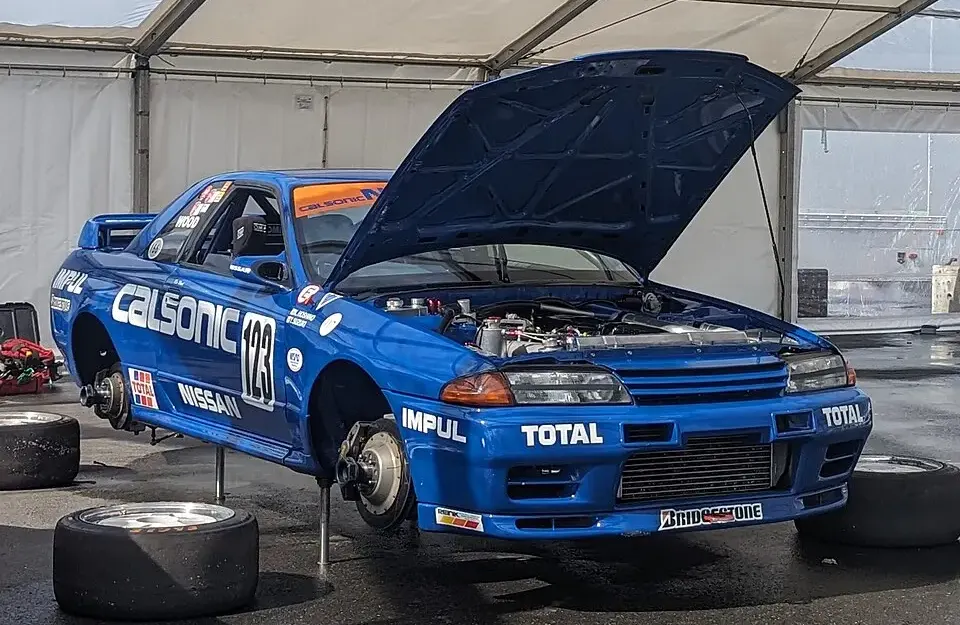

For fourteen seasons, Japan had its own touring-car championship, and it was one of the most varied in the world: Skyline GT-Rs, a Ford Sierra, BMW M3s, Honda Civics and later Super Touring Accords all raced for national titles.
A Group A series, 1985 to 1993
The championship revived in 1985 for FIA Group A cars, split into three divisions by engine size. The top and bottom divisions swapped their numbers in 1988, so this article calls them top, middle and smallest. According to Wikipedia's JTCC article, the top division in the late 1980s was contested by Toyota Supras, Nissan Skylines and the European Ford Sierra RS500. The middle division was mainly BMW M3s, and the smallest division was Honda Civics and Toyota Corollas.
The year's big event was the InterTEC 500 km at Fuji, which pulled in teams and drivers from Europe and Australia, including Tom Walkinshaw, Peter Brock and Allan Moffat. In 1987 it was part of the World Touring Car Championship calendar.
The top division: Skylines and a Sierra
The first champion car was a BMW 635CSi in 1985, then a NISMO Nissan Skyline RS driven by Aguri Suzuki in 1986. Ford's Sierra RS500 Cosworth then won in 1987 and 1988 for Object T, with Naoki Nagasaka and Hisashi Yokoshima. Nissan answered with the Skyline GTS-R (HR31), which won in 1989 for Hasemi.
Then came the car that ended the argument. The Skyline GT-R (BNR32) began its Group A campaign in 1990, and Wikipedia's Skyline GT-R article says it won every one of the 29 JTCC races it entered. It took the top-division title four years in a row: Kazuyoshi Hoshino for Impul in 1990, Masahiro Hasemi for Hasemi Motorsport in 1991 and 1992, and Masahiko Kageyama for Impul in 1993. By 1993, the JTCC article says, the GT-R was the only car in that category.
Outside Japan the same car won the 1991 and 1992 Bathurst 1000 and the 1991 Spa 24 Hours. Its motorsport-oriented all-wheel-drive system, ATTESA E-TS, was developed for the R32, which Australian magazine Wheels had already nicknamed "Godzilla" in 1989. Details of the GT-R's JTCC entry are on its race car page.
The middle division: the BMW M3 years
The E30 BMW M3 won the middle division every year from 1987 to 1993. The list of winners includes Haruto Yanagida (1987 to 1988), Kenji Takahashi (1989), Roland Ratzenberger (1990 and 1991), Kazuo Mogi (1992) and Andrew Gilbert-Scott (1993).
The smallest division: Corollas and Civics
The smallest division was a manufacturer fight between Toyota and Honda. The rear-drive Corolla Levin (AE86) won the first title in 1985. Honda's Civics, with Mugen, then took 1987 and 1988 with Osamu Nakako, before the front-drive Corolla Levin (AE92) won in 1989 and 1990 for Tsuchiya Engineering. The Civic returned for 1991 and 1992 with the SiR (EF9), then the SiR (EG6) won in 1993 for Mooncraft with Naoki Hattori.
Super Touring, 1994 to 1998
For 1994 the series switched to the FIA Super Touring formula, and Japan's big three entered new cars: the Nissan Primera, the Honda Civic Ferio and Accord, the Toyota Corona and the E110 Corolla. The champions were:
- 1994: Masanori Sekiya, Toyota Corona, TOM'S.
- 1995: Steve Soper, BMW 318i (E36), Schnitzer. The JTCC article calls it the only all-foreign championship win of the Super Touring era.
- 1996: Naoki Hattori, Honda Accord, Mooncraft.
- 1997: Osamu Nakako, Honda Accord, Mugen.
- 1998: Masanori Sekiya, Toyota Chaser, TOM'S.
Why it ended
The 1998 season was the last. According to the JTCC article, Nissan withdrew because of financial problems, and Honda left to concentrate on its Formula One programme, which Mugen supplied at the time. It was also cheaper for Honda to race its NSX in the JGTC. That left Toyota as the only works manufacturer, with Corona EXIVs and Chasers, and the odd privately run Subaru Impreza wagon. A planned 1999 replacement with spaceframe cars came to nothing. The big three then put their works effort into the JGTC, which is now called Super GT.
Every champion car on the site
| Car | Titles |
|---|---|
| Nissan Skyline RS Turbo (DR30) | 1986, top division |
| Ford Sierra RS500 Cosworth | 1987 and 1988, top division |
| Nissan Skyline GTS-R (HR31) | 1989, top division |
| Nissan Skyline GT-R (BNR32) | 1990 to 1993, top division |
| BMW M3 (E30) | 1987 to 1993, middle division |
| Toyota Corolla Levin (AE86) | 1985, smallest division |
| Toyota Corolla Levin (AE92) | 1989 and 1990, smallest division |
| Honda Civic SiR (EF9) | 1991 and 1992, smallest division |
| Honda Civic SiR (EG6) | 1992 and 1993, smallest division |
| Toyota Corona (T190) | 1994, Super Touring |
| BMW 318i (E36) | 1995, Super Touring |
| Honda Accord (CD6) | 1996 and 1997, Super Touring |
| Toyota Chaser (X100) | 1998, Super Touring |
The full list is on the JTCC series page.
Sources
Sources disagree on some details, and the Wikipedia JTCC page is inconsistent in places, so we have kept to what both of our sources support. Spotted an error? Tell us.
Frequently asked questions
What was the JTCC?
The All Japan Touring Car Championship, Japan's national touring-car series. It ran from 1985 to 1998: first as a Group A series with three divisions by engine size, then from 1994 as a Super Touring series for production-based 2.0-litre cars.
Which car dominated the Group A JTCC?
The Nissan Skyline GT-R (BNR32). It won the top division every year from 1990 to 1993, and by 1993 it was the only car left in that division. Wikipedia's R32 article says it won all 29 JTCC races it entered.
Which cars won the JTCC in the Super Touring era?
The Toyota Corona in 1994, the BMW 318i in 1995 (the only all-foreign title of the Super Touring era), the Honda Accord in 1996 and 1997, and the Toyota Chaser in 1998.
Why did the JTCC end?
After 1998, Nissan withdrew for financial reasons and Honda left to focus on Formula One, which left Toyota as the only works manufacturer. The big three then took their works programmes to the JGTC, now called Super GT. Later revival plans did not last.