
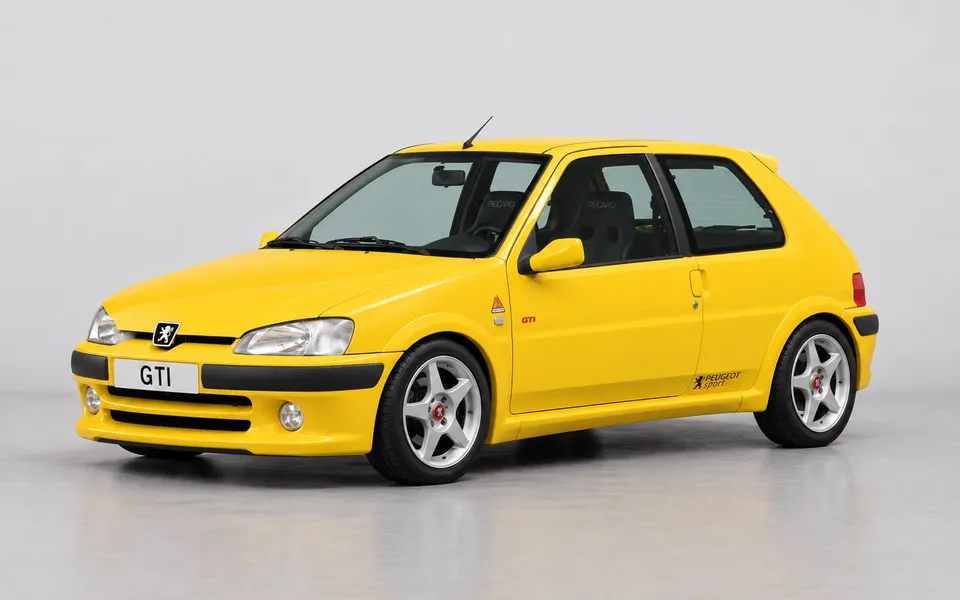
Car
Peugeot 106 specifications
The Peugeot 106 is a car. The classic 106 (1st generation, facelift) ranges from 50 hp (37 kW) to 117 hp (87 kW) across its 21 versions. It measures 3,678 mm (145 in) long on a 2,385 mm wheelbase.
- How much horsepower does the Peugeot 106 have?
- The classic 106 (1st generation, facelift) makes 50–117 hp (37–87 kW), depending on the version.
- How big is the Peugeot 106?
- It is 3,678 mm (145 in) long, 1,594 mm (63 in) wide and 1,376 mm (54 in) tall. A typical kerb weight is 780 kg (1,720 lb).
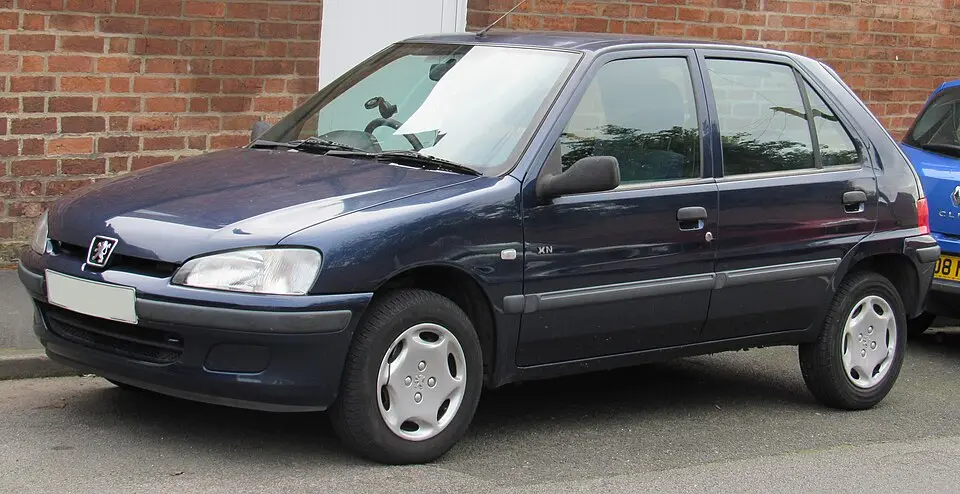
- 50–117 hp
- Power (37–87 kW)
- 74–145 Nm
- Torque (55–107 lb-ft)
- 8.7–19.4 s
- 0–100 km/h (fastest to slowest version)
- 3,678 mm
- Length (145 in)
A classic model, no longer on sale, so it has no 2025 sales data. Its performance versions are in our performance section.
Versions and performance
1st generation, facelift, 1996–2004: 21 versions (hatchback), from least to most powerful. Figures are manufacturer claims and vary by market.
| Version | Engine | Power | Torque | 0–100 km/h | Top speed | Gearbox | Drive |
|---|---|---|---|---|---|---|---|
| 1.0 MT Hatchback 5-doors | 1.0 litre gasoline | 50 hp (37 kW) | 74 Nm | 19.4 s | 150 km/h | Manual, 5-speed | Front wheel drive |
| 1.0 MT Hatchback 3-doors | 1.0 litre gasoline | 50 hp (37 kW) | 74 Nm | 19.4 s | 150 km/h | Manual, 5-speed | Front wheel drive |
| 1.5 D MT Hatchback 5-doors | 1.5 litre diesel | 56 hp (42 kW) | 116 Nm | 18 s | 158 km/h | Manual, 5-speed | Front wheel drive |
| 1.5 D MT Hatchback 3-doors | 1.5 litre diesel | 56 hp (42 kW) | 116 Nm | 18 s | 158 km/h | Manual, 5-speed | Front wheel drive |
| 1.5 MT Hatchback 5-doors | 1.5 litre diesel | 56 hp (42 kW) | 95 Nm | 18.5 s | 158 km/h | Manual, 5-speed | Front wheel drive |
| 1.5 MT Hatchback 3-doors | 1.5 litre diesel | 56 hp (42 kW) | 95 Nm | 18.5 s | 158 km/h | Manual, 5-speed | Front wheel drive |
| 1.1 MT Hatchback 5-doors | 1.1 litre gasoline | 59 hp (44 kW) | 91 Nm | 15.4 s | 165 km/h | Manual, 5-speed | Front wheel drive |
| 1.1 MT Hatchback 3-doors | 1.1 litre gasoline | 59 hp (44 kW) | 88 Nm | 13.7 s | 165 km/h | Manual, 5-speed | Front wheel drive |
| 1.4 AT Hatchback 5-doors | 1.4 litre gasoline | 74 hp (55 kW) | 111 Nm | 17 s | 166 km/h | Automatic, 3-speed | Front wheel drive |
| 1.4 AT Hatchback 3-doors | 1.4 litre gasoline | 74 hp (55 kW) | 111 Nm | 17 s | 166 km/h | Automatic, 3-speed | Front wheel drive |
| 1.4 MT Hatchback 5-doors | 1.4 litre gasoline | 74 hp (55 kW) | 111 Nm | 13.2 s | 178 km/h | Manual, 5-speed | Front wheel drive |
| 1.4 MT Hatchback 3-doors | 1.4 litre gasoline | 74 hp (55 kW) | 111 Nm | 10.7 s | 175 km/h | Manual, 5-speed | Front wheel drive |
| 1.6 AT Hatchback 3-doors | 1.6 litre gasoline | 87 hp (65 kW) | 135 Nm | 13.5 s | 176 km/h | Automatic, 3-speed | Front wheel drive |
| 1.6 AT Hatchback 5-doors | 1.6 litre gasoline | 87 hp (65 kW) | 135 Nm | 13.5 s | 178 km/h | Automatic, 3-speed | Front wheel drive |
| 1.6 MT Hatchback 3-doors | 1.6 litre gasoline | 87 hp (65 kW) | 135 Nm | 12.2 s | 185 km/h | Manual, 5-speed | Front wheel drive |
| 1.6 MT Hatchback 5-doors | 1.6 litre gasoline | 87 hp (65 kW) | 135 Nm | 12.2 s | 185 km/h | Manual, 5-speed | Front wheel drive |
| 1.6 AT Hatchback 5-doors | 1.6 litre gasoline | 89 hp (66 kW) | 135 Nm | 13 s | 178 km/h | Automatic, 3-speed | Front wheel drive |
| 1.6 MT Hatchback 5-doors | 1.6 litre gasoline | 89 hp (66 kW) | 135 Nm | 12 s | 185 km/h | Manual, 5-speed | Front wheel drive |
| 1.6 MT Hatchback 3-doors | 1.6 litre gasoline | 99 hp (74 kW) | 132 Nm | 9.6 s | 195 km/h | Manual, 5-speed | Front wheel drive |
| 1.6 MT Hatchback 5-doors | 1.6 litre gasoline | 99 hp (74 kW) | 132 Nm | 9.6 s | 195 km/h | Manual, 5-speed | Front wheel drive |
| 1.6 MT Hatchback 3-doors | 1.6 litre gasoline | 117 hp (87 kW) | 145 Nm | 8.7 s | 205 km/h | Manual, 5-speed | Front wheel drive |
Dimensions and weight
Full Peugeot 106 dimensions, with a size comparison to rivals →
| Length | 3,678 mm | 145 in |
|---|---|---|
| Width | 1,594 mm | 63 in |
| Height | 1,376 mm | 54 in |
| Wheelbase | 2,385 mm | 94 in |
| Ground clearance | 130 mm | 5 in |
| Kerb weight | 780–950 kg | 1,720–2,094 lb |
| Boot space | 215–953 litres | 8–34 cu ft |
| Seats | 5 | |
| Turning circle | 9.6 m | 31 ft |
| Fuel tank | 45 litres | 12 US gal |
Where it's sold, and what it's called
| Market | Sold as | 2025 sales rank |
|---|
Generations
Every version of each generation, with power, torque and performance figures.
- 1st generation 1991–1996
- 1st generation, facelift 1996–2004
Questions about the Peugeot 106
How much horsepower does the Peugeot 106 have?
The classic 106 (1st generation, facelift) makes 50–117 hp (37–87 kW), depending on the version.
How much torque does the Peugeot 106 have?
Between 74 and 145 Nm (55–107 lb-ft) for the 1st generation, facelift, depending on the engine.
How fast is the Peugeot 106 from 0 to 100 km/h (0–60 mph)?
The quickest version takes 8.7 seconds from 0 to 100 km/h (about 8.3 s to 60 mph); the slowest takes 19.4 seconds.
What is the top speed of the Peugeot 106?
Up to 205 km/h (127 mph) for the fastest version; the slowest tops out at 150 km/h (93 mph).
How big is the Peugeot 106?
It is 3,678 mm (145 in) long, 1,594 mm (63 in) wide and 1,376 mm (54 in) tall. A typical kerb weight is 780 kg (1,720 lb).
Performance versions of the Peugeot 106
The fastest Peugeot 106 variants have their own pages, with full specs and head-to-heads.
Similar hatchbacks and small cars
Sources: EEA CO₂ monitoring 2025 (engines), RDW open data and manufacturer data (dimensions, versions), FuelEconomy.gov (US ratings), Wikidata Q826094, Wikipedia. Figures are typical values and vary by trim and year. Data last updated .