The Mugen Motul Civic: the Honda hatchback that won every race in its JTCC class in 1987
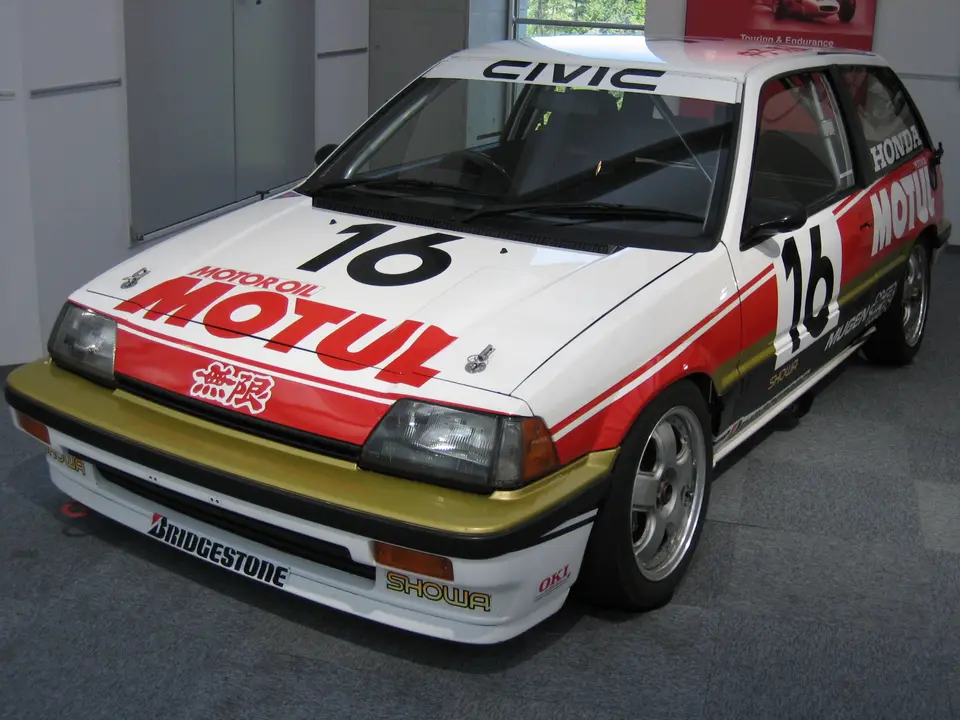

In 1987 a 1.6-litre front-drive hatchback with a gold front bumper and a big Motul bonnet logo won every race in its class in Japan's touring car championship, sometimes qualifying ahead of cars with more than twice its engine size. It was the Mugen Motul Civic, and it was the last of Honda's early Civics to race in Group A.
The car: a Civic Si with a Mugen engine
The base car was the third-generation Honda Civic Si, the hatchback that joined the Civic range in 1984. Its engine was the 1.6-litre, twin-cam, 16-valve ZC, the same engine used in early CR-Xs. Group A rules kept the car recognisable: it had to look like a road car, with a production run of at least 5,000, and the standard engine block, cylinder head and single-throttle-body inlet manifold stayed, though the engine could be blueprinted and the cams and engine management changed.
Mugen, the tuning company started by Honda's founder's son Hirotoshi Honda, did the engine work. Motul supplied the sponsorship and the colours that the car is remembered for: white with a red and gold scheme, the number 16 on the bonnet and doors, and the Mugen kanji (無限) under the Motul name on the nose.
Power and weight: the numbers do not agree
This is the part of the story where the sources disagree, so here they are side by side.
- Road car: one account puts the Civic Si ZC at 108 hp (81 kW); another puts the early Si at 133 hp (99 kW). These are probably different specs or markets, and the articles do not say which.
- Race engine: Japanese Nostalgic Car gives a range of 178 to 222 hp (132 to 166 kW), "depending on which source you believe" (converted from the metric figures it quotes). Another account says both the Civic and its Corolla rival made about 178 hp (132 kW). Motul's own article is reported to say more than 225 hp (168 kW) at 9,500 rpm without a turbo, but we could not read that page ourselves, so treat it as unconfirmed.
- Weight: the cars could be lightened down to the class minimum, which one account puts at 780 kg. The road Si was around 910 kg. We found no verified weight for the race car itself.
Whatever the true figure, the formula was simple: a light front-drive car with a high-revving, naturally aspirated four that had been carefully built rather than boosted.
Honda's road to 1987
Honda joined the Group A touring car series midway through 1985, too late to score enough points to contend for that year's title, which went to Toyota in the smallest class. 1986 was a Toyota year too: the Corolla FX won all but the first race, which Honda took. By 1987 the Civic and Mugen had caught up, and it was the season everything came together.
1987: every race in the class
Accounts agree that in 1987, the last year Honda ran the EA-generation car, the Mugen Motul Civic won every race in its class. The drivers named are Osamu Nakako and Hideki Okada. One account has the car taking pole at one Group A round, ahead of Skylines and BMW 6-series coupes with more than double the displacement. That is a single secondary account and we have not seen the timing sheet, so we would not push it harder than that.
Two things need a careful reading. First, this was a class win, not an overall win. The overall winners of the 1987 rounds, per Wikipedia's season page, were the Ford Sierra RS500, the Mitsubishi Starion and a Toyota Supra, and the overall champion was Naoki Nagasaka for Object T. Second, the class name varies. Some write-ups call the smallest class Division 3, others call it the 1600 class, and an older article calls it Division 1. These appear to be the same under-1.6-litre class described at different times, but we did not find a source that says so directly.
1988 and after
For 1988 Honda moved to the next Civic, the EF, with Mugen's work now on a newer engine. The FIA's historic database lists the Civic 3-door EF3 in Group A from March 1988, and a Hasegawa model kit sold as the "1988 JTC champion". Figures for that car vary: the stock SiR's B16A is put at 158 hp (118 kW), raised to about 205 hp (153 kW) by Mugen in one account and about 212 hp (158 kW) in another. The Civic went on to win the series trophy five times in the nine years of the All-Japan championship, against four for the Corolla. Honda later came back with the SiR (EF9) and the SiR (EG6).
Watch it
For the wider story of the series, see the JTCC history.
Sources
- Japanese Nostalgic Car: Honda Civic racing history
- Japanese Nostalgic Car: Group A Division 1, racing the shopping trolleys
- Wikipedia: 1987 Japanese Touring Car Championship
- Motul: I built my own Mugen Motul racing car (as summarised in search results; not read in full)
- FIA Historic Database: Honda Civic 3-door
- Japanese Nostalgic Car: Honda Collection Hall Civic World
Figures and class names vary between sources. We have flagged where they disagree. Spotted an error? Tell us.
Frequently asked questions
What was the Mugen Motul Civic?
A Group A race car built on the third-generation Honda Civic Si (the twin-cam ZC engine, 1.6 litres), prepared by Honda's tuning house Mugen and sponsored by Motul. It ran as car number 16 in the All Japan Touring Car Championship.
Who drove it in 1987?
Osamu Nakako and Hideki Okada, according to the accounts we found. Honda's own museum car is the number 16 Mugen Motul Civic.
Did it win the 1987 championship?
It won its class, not the overall race. Accounts say it won every race in its division that year, while the overall winners of the 1987 rounds were Sierra RS500s, Mitsubishi Starions and a Toyota Supra. The overall 1987 champion was Naoki Nagasaka (Object T), per Wikipedia.
How much power did the race engine make?
Sources disagree: roughly 178-222 hp (132-166 kW) is the range quoted, and Motul's own write-up is reported to claim more than 225 hp (168 kW). None of the figures is an official dyno number.
Where can you see the car today?
In the Honda Collection Hall at Twin Ring Motegi in Japan, where the number 16 car is on display.